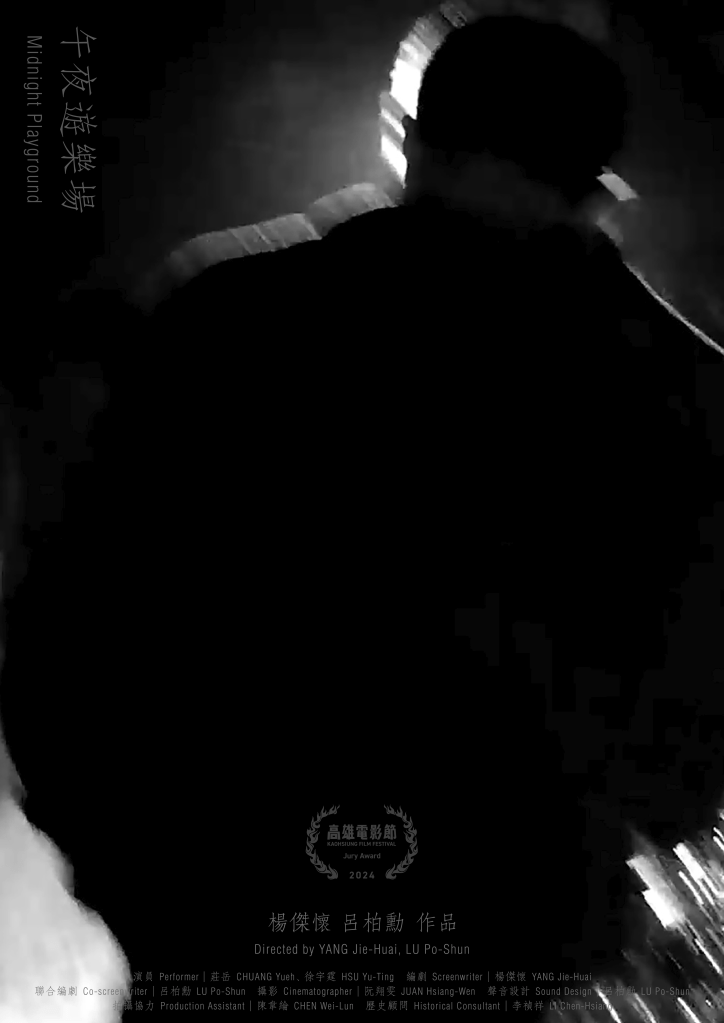
Midnight Playground
午夜遊樂場
polyethylene slide, iron components, rubber mats, LED light tubes, wooden structures, single-channel video A (HD, black and white, 5.1 sound, looped), single-channel video B (4K, color, stereo sound, looped) | dimensions variable | video A length 25’ 10 | video B length 12’ 40” | 2023
聚乙烯滑梯、鐵製零件、橡膠地墊、LED 燈管、木作、單頻道動態影像 A(HD,黑白,5.1 環繞聲,循環播放)、單頻道動態影像 B(4K,彩色, Stereo 立體聲,循環播放)
In normal circumstances, the “playground” in a park, and the act of “playing” within it, evoke feelings of joy, relaxation, and childhood memories. However, in the artwork Midnight Playground, the artists offer a reinterpretation of the daytime park experience through the lens of queer culture, unveiling a hidden world of play that emerges under the cover of night, blending secrets, desires, and even elements of violence.
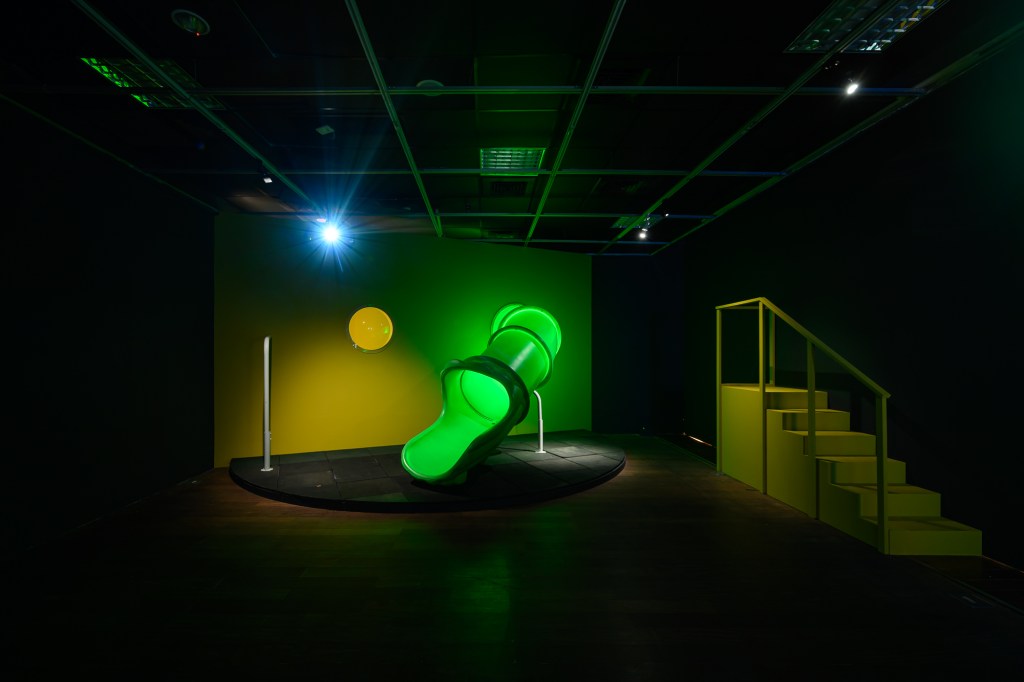
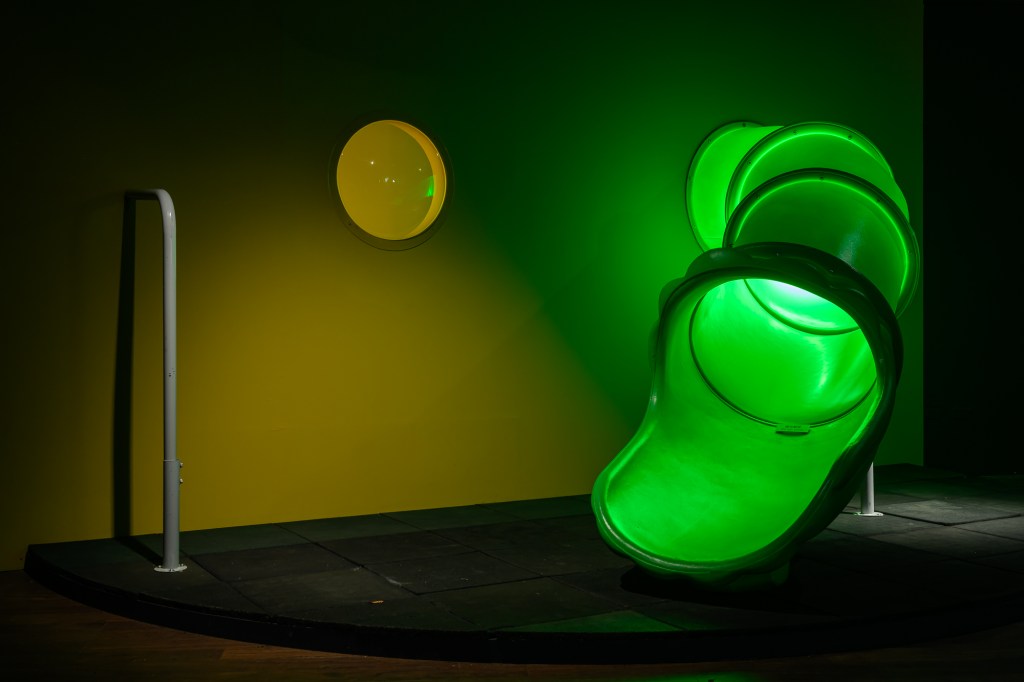
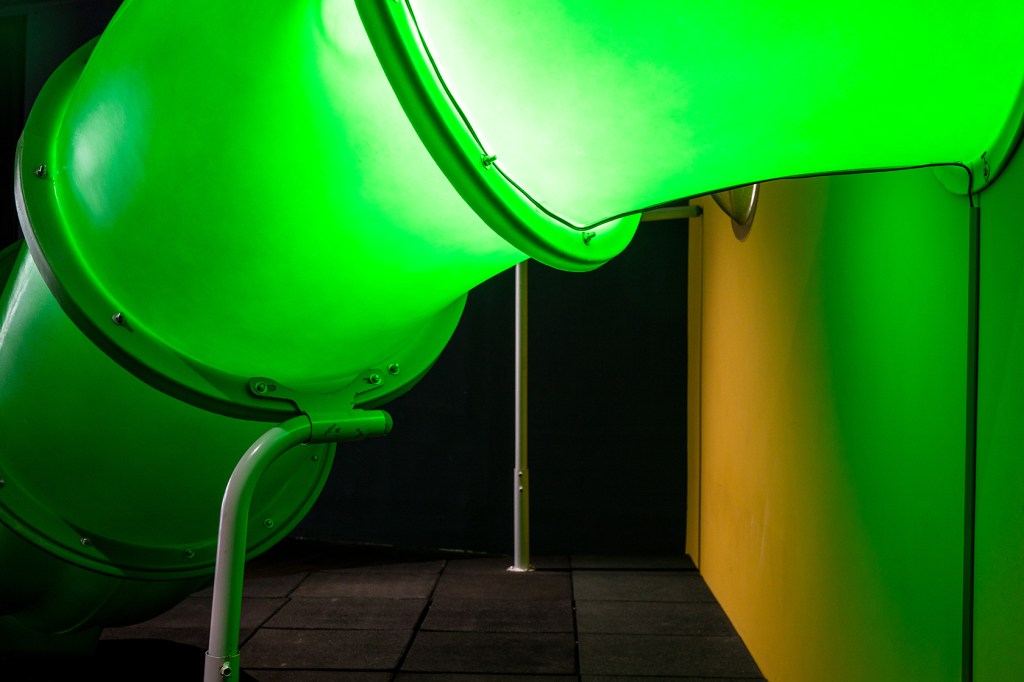
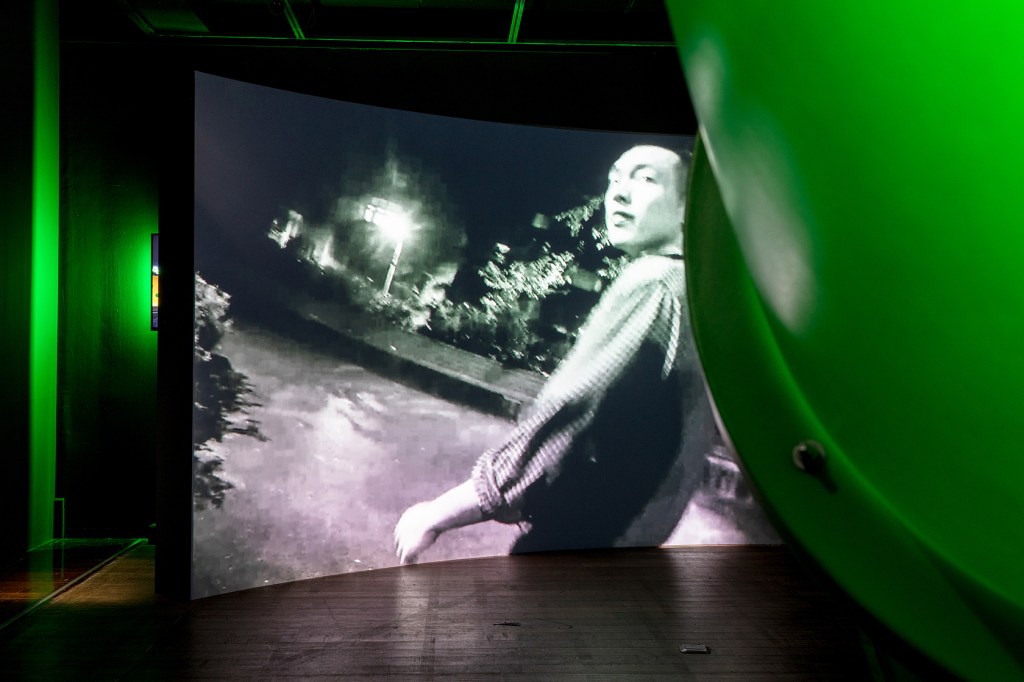
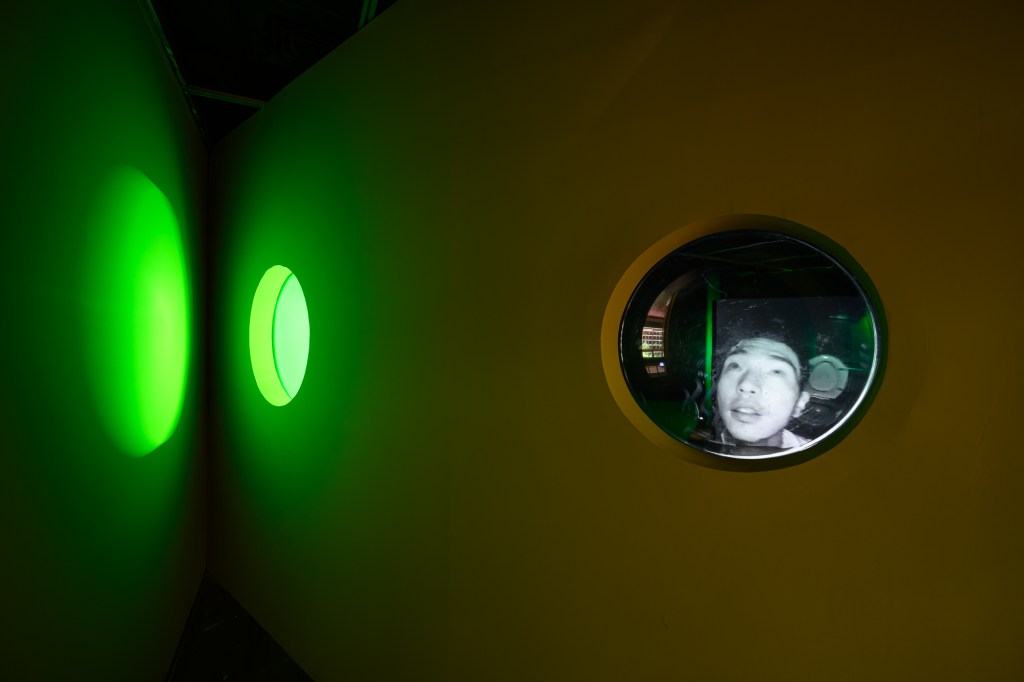
The artwork features a simulated park slide and two video installations, labeled A and B, all set in park settings. The artists merge childhood play experiences and the compressed bodily imagery of adult queers within the narrow spaces of the slide and the cubicle. On the other hand, the videos interweave the artist’s intimate encounters and conversations with strangers in the park, alongside a narrative depicting a miscarriage of justice during the White Terror era at Taipei New Park (now 228 Peace Memorial Park) in the 1950s (see Note 1).
The artists trace the origins of queer park culture back to an earlier time—since the establishment of New Park, it has served as a vital social hub for Taipei’s queer community. However, when New Park is documented in materials related to the White Terror era (see Note 2), desire, politics, and public space are encompassed within a unique network of relations.
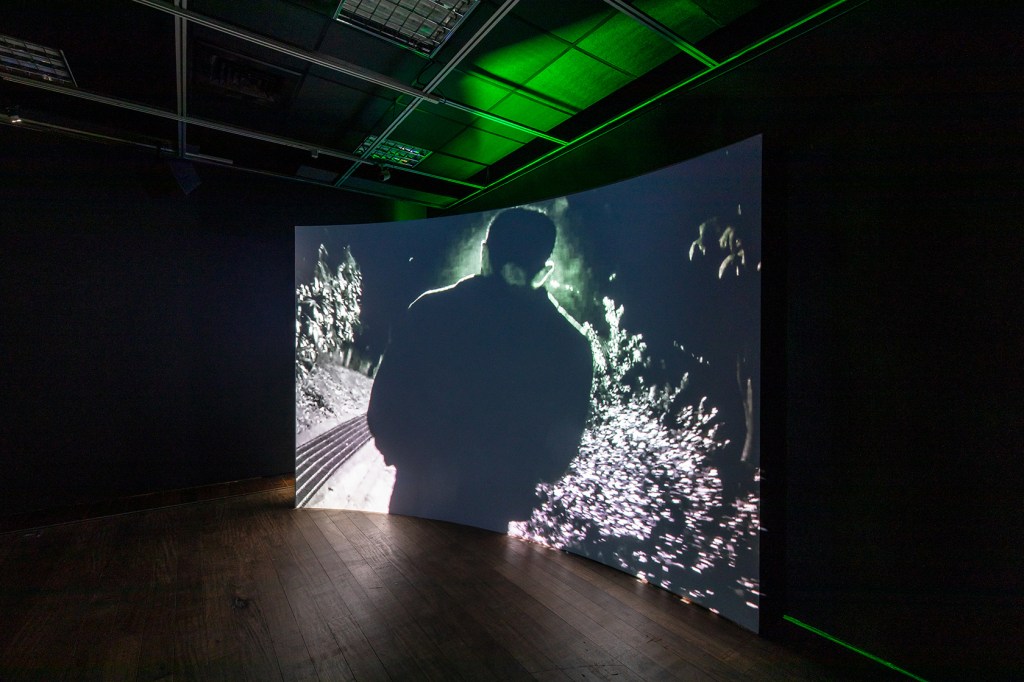
In video A, two performers portray past incident using the language and lifestyle of contemporary youth, employing a long take technique. Shot from a hidden camera worn by one of the performers, the footage provides a first-person perspective, blurring the lines between documentary and drama.
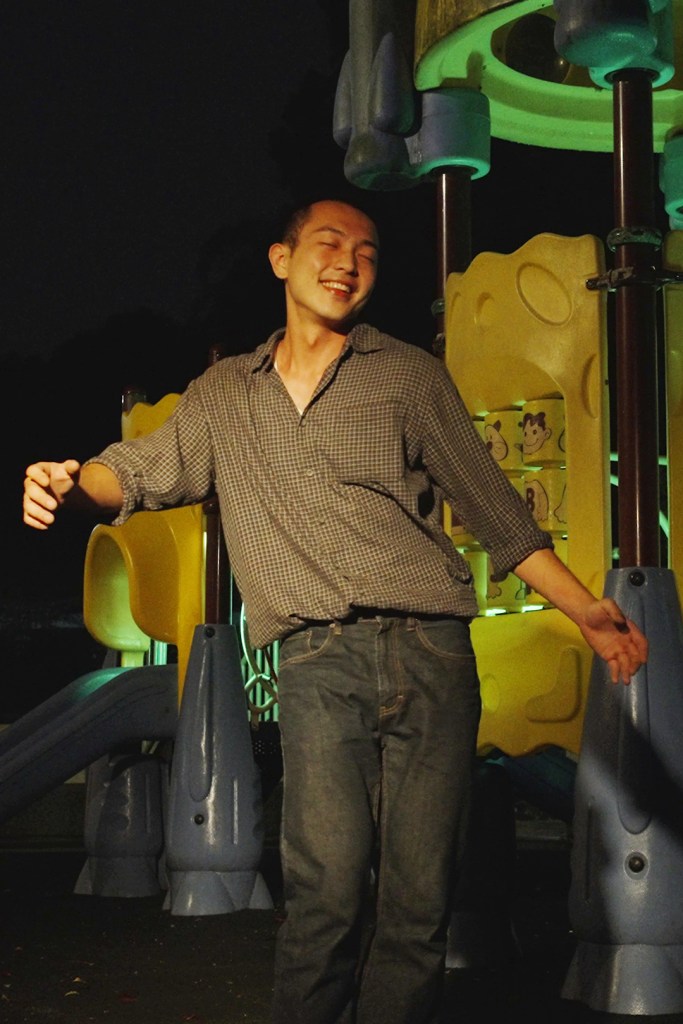
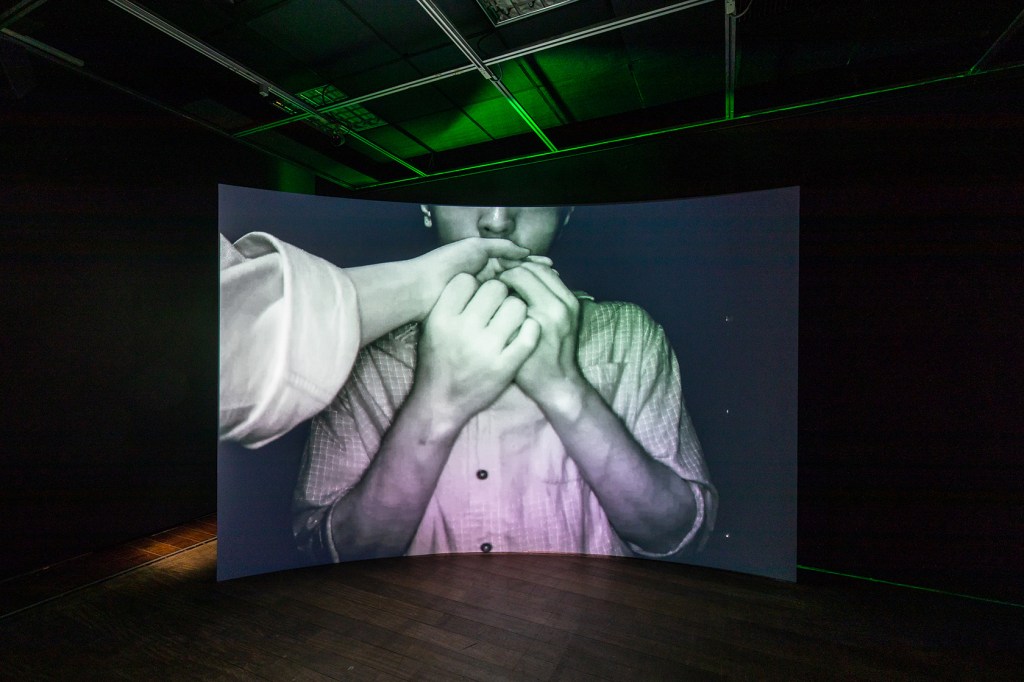
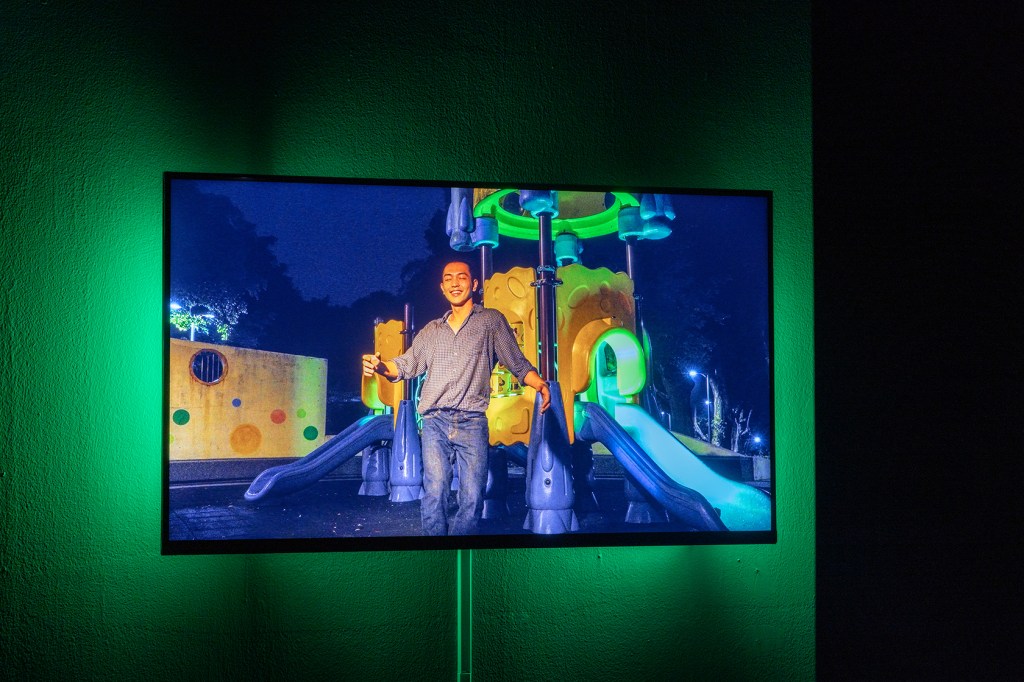
If video A represents the interpretation before the incident occurred, video B depicts the imagination of what happened afterward. Here, a performer is seen alone, playing in front of the playground equipment, as the narrative delves into the concept of “play,” exploring its darker aspects.Through a narrative spanning multiple time layers, the artists reflect on the evolving violence experienced by queers in public spaces across different temporal and spatial contexts, as well as the shifting definitions of perpetrator and victim roles within them.
Note 1: During Taiwan’s martial law period, under the “Anti-Rebellion Act,” in October 1954, some dissenters hung anti-government slogans and propaganda materials in Taipei New Park. Despite several days of searching by investigation units, no leads were found. However, on a rainy night of October 24th, a young man named Liang-Sheng Huang visited New Park as usual. After wandering for a while, he encountered a handsome stranger.
As they walked together towards a dark corner, the man revealed himself as an undercover military police officer and arrested Huang. He had spotted Huang during patrols in New Park and deemed him suspicious, linking him to the “rebellion case” involving the distribution of subversive slogans.
Under coercion and false testimony, Huang received a ten-year prison sentence. It wasn’t until 1956 when the investigation unit apprehended the real perpetrators of the rebellion, leading to the reversal of Huang’s sentence. After enduring torture and over two years of imprisonment, Huang was released, but by then, he had suffered a mental breakdown.
Note 2: See the article “Homosexual White Terror: Rainy Night Terror in the New Park” by Chen-Hsiang Li, “Taiwan People News”, 2018.
About the Co-Creators | Po-Shun LU, an independent filmmaker who graduated from the National Taiwan University of Arts. He is committed to creating film-related works and frequently assumes the role of director. His creations are often inspired by his personal experiences and reflect the lives of lower-class individuals in Taiwan. Additionally, he explores how images can be utilized to navigate personal life stories and extend to encompass the survival conditions of communities and collectives.
VR online exhibition of display at MoCA Taipei
Collaboration | Po-Shun LU
Post-Production | Po-Shun LU
Performers|Yueh CHUANG, Yu-Ting HSU
Cinematographer|Hsiang-Wen JUAN
Production Support|Wei-Lun CHEN
Historical Consultant|Chen-Hsiang LI
Photo Credit | MoCA Taipei
Exhibition Photographer | ANPIS FOTO, Hsiang-Ting LO
The work was funded by MoCA Taipei and Chi-Wen Productions.
展場裝置
在一般情況下,公園的「遊樂場」,或者我們在遊樂場當中「玩」的行為,是歡樂、輕鬆,甚至是童年美好回憶的表徵。然而,在作品《午夜遊樂場》中,藝術家透過酷兒文化的公園場景,重新詮釋了白天公園的印象,讓隱藏在黑夜裡,一種混雜著秘密、情慾和暴力的「玩」得以展現。
作品包括一座模擬的公園滑梯,以及 A、B 兩部以公園為場景的動態影像。藝術家將童年時幻想進入太空艙的遊戲感受,以及成人酷兒壓縮的身體意象,在狹窄的滑梯通道和小隔間中融合在一起。另一方面,影像則穿插交疊藝術家在公園與陌生人交談的私密經驗,以及一則發生在 1950 年代臺北新公園(現為 228 和平紀念公園)的白色恐怖冤案敘事(註 1)。
藝術家追朔酷兒的公園文化至更早的時期——新公園自建造以來就一直是臺北酷兒社交的重要場所。然而,當它被紀錄在白色恐怖相關的文獻中(註 2),情慾、政治與公共空間即被囊括進一種特殊的關係網絡。
影像 A 中,兩位表演者以當代人的語氣和生活狀態詮釋這段過去的事件,並以一鏡到底的方式表演。影像以其中一位表演者身上的秘錄攝影機拍攝,第一人稱的視角呈現敘事中「調查者」的角色位置,及其「蒐證」的動作,使得整部影像在紀錄片和劇情片之間切換。
若影像 A 是事件發生前的詮釋,裝置在其背後的影像 B 則描繪了事件發生後的想像。表演者獨自在遊樂設施前遊戲,敘事重返「玩」的概念,探索其中黑暗的一面。藝術家透過多重時間層面的敘事,反思不同時空下酷兒在公共關係中所遭受的暴力變遷,以及其中加害者和被害者角色的不同定義。
註 1:在臺灣戒嚴時期,以及《懲治叛亂條例》的法令下,1954 年 10 月,一些異議人士在臺北新公園懸掛了反政府的標語和宣傳品。調查單位連續幾天進行搜索,但沒有取得任何收穫。然而,就在 10 月 24 日的一個下著細雨的夜晚,一位名為黃良盛的年輕人像往常一樣來到新公園尋歡。在那裡閒逛一陣子後,他終於遇到了一位英俊的陌生男子。
當他們一起朝著一個陰暗的角落走去時,男子才透露自己的真實身份,並將黃良盛上手銬逮捕。原來,這位男子是一名便衣憲兵,在新公園巡邏時發現了黃良盛,認為他形跡可疑,因此將其視為涉嫌散佈反動標語的「叛亂案」嫌疑人。
在刑求逼供和偽證的情況下,法院判處黃良盛十年有期徒刑。直到 1956 年,調查單位破獲了真正的兩名叛亂案犯人,導致黃良盛的判決最終被撤銷。經過刑求的折磨和兩年多的監禁,當黃良盛獲釋時,他已經精神崩潰。
註 2:參見文史工作者李禎祥文章〈同性戀白色恐怖:新公園之雨夜驚魂〉,《民報專欄》,2018。
關於共同創作者|呂柏勳,獨立電影導演,畢業於國立臺灣藝術大學圖文傳播藝術學系雙主修電影學系,致力於影像相關創作。作品多以自身經驗轉化,透過影像整理自己的生命軌跡,並擴延至族群,甚至集體的生命狀態。
共同創作|呂柏勳
影像及聲音後製|呂柏勳
演員|莊岳、徐宇霆
攝影|阮翔雯
拍攝協力|陳韋綸
歷史顧問|李禎祥
圖片提供|臺北當代藝術館
展場攝影|ANPIS FOTO 王世邦、羅祥庭
本作品由臺北當代藝術館以及 Chi-Wen Productions 贊助製作
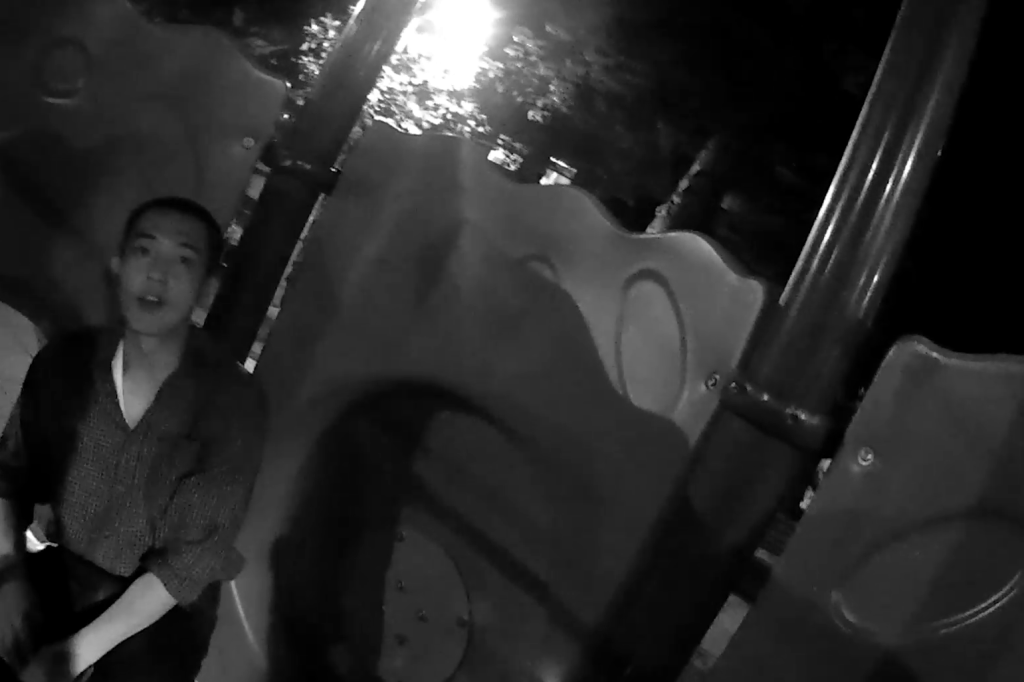
影像 A 以表演者身上的秘錄攝影機呈現調查者的角色位置
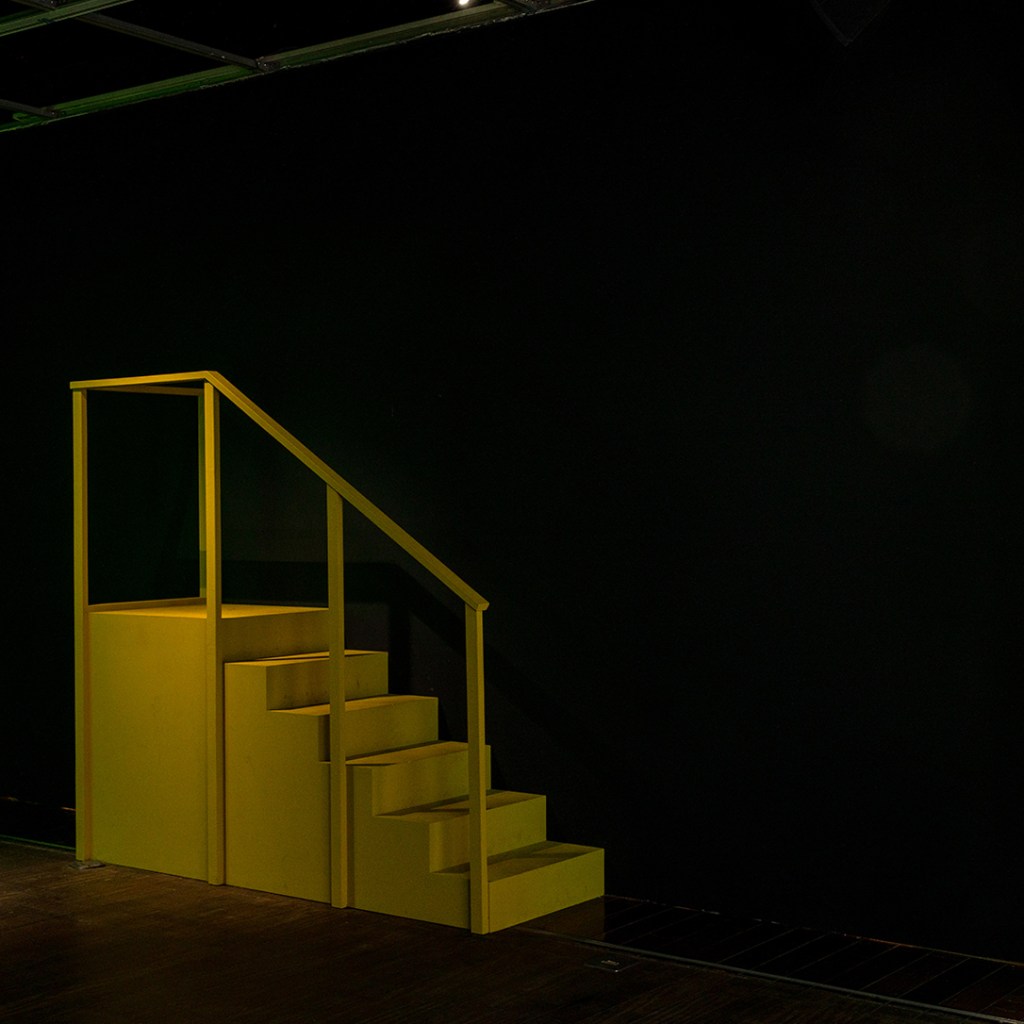
可以坐的樓梯
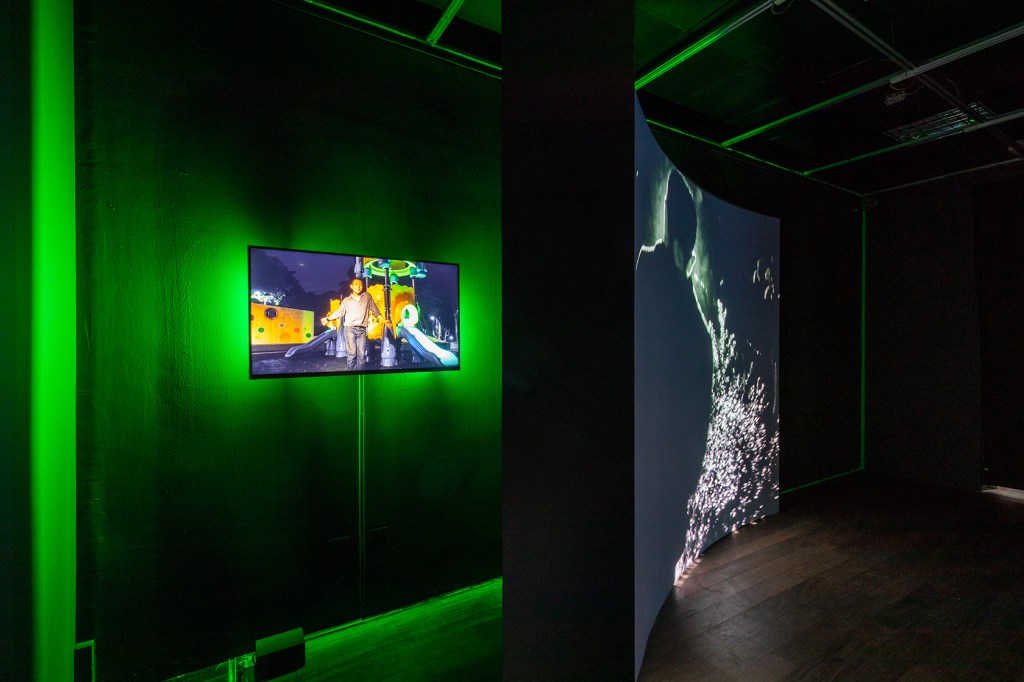
裝置在影像 A 後面的影像 B

展場中的小隔間
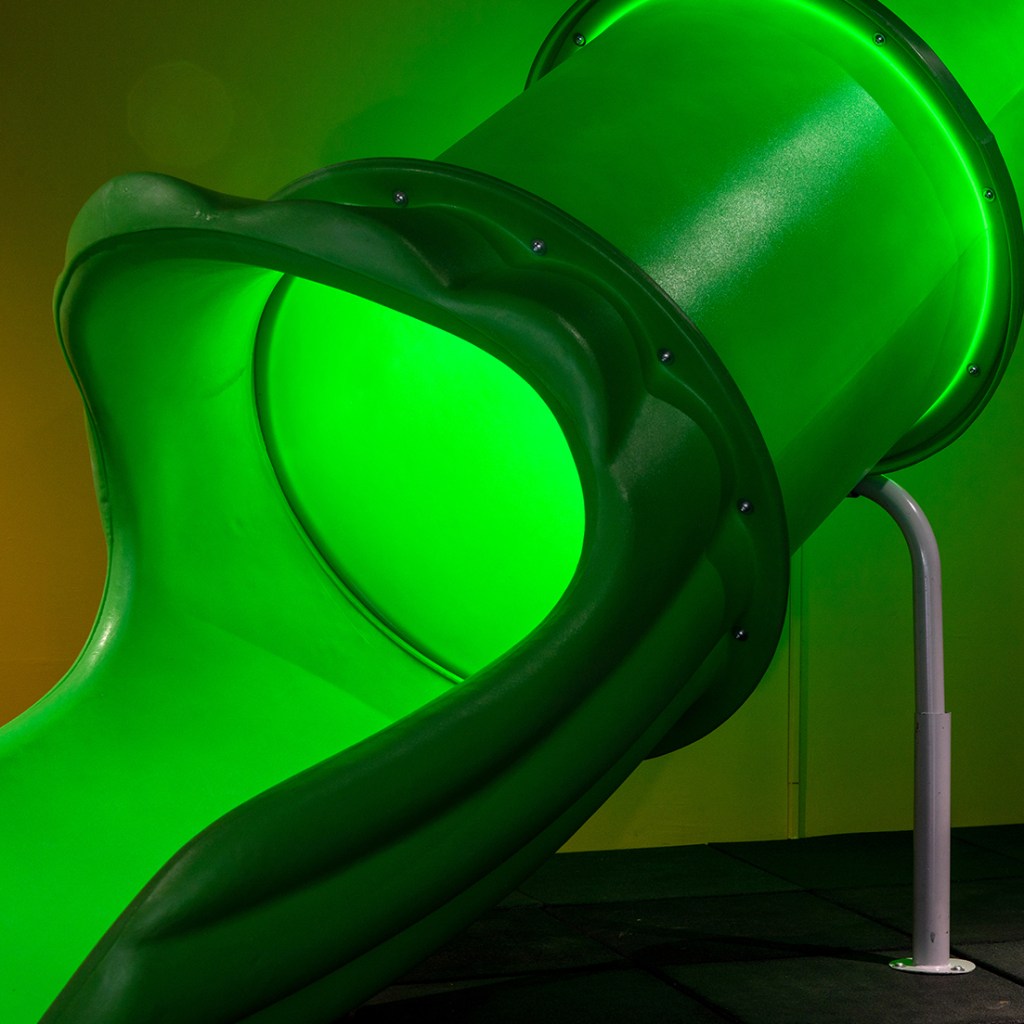
滑梯裝置
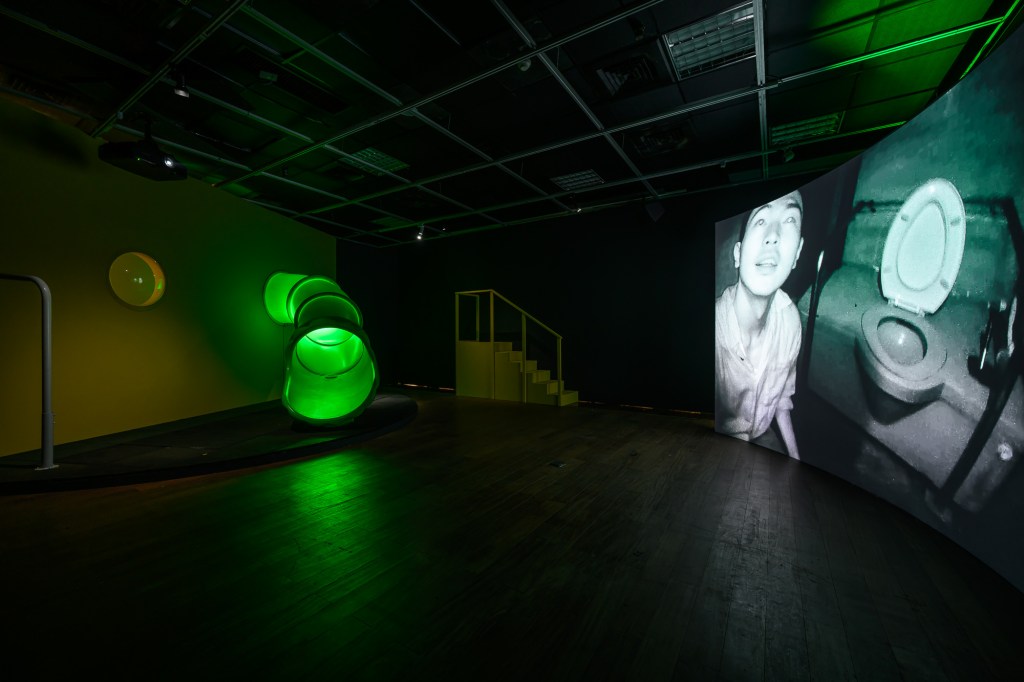

 JIE-HUAI YANG|楊傑懷